Water
Boatmen
Order: Hemiptera
Family: Corixidae
Identifying
Features
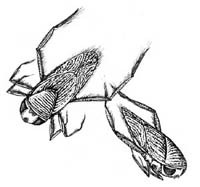
Water boatmen can be recognized by the two long rear legs which they
use as very effective sweeping oars. They breath atmospheric oxygen
and must regularly travel to the surface to replenish the air supply
they carry in a specially-adapted abdominal pocket. This gives the abdomen
a silvery sheen; fish key to this. Backs are dark brown and the undersides
pale yellow to whitish.
What
to Look For
Very quick-swimming beetle-like creatures darting to the surface, pausing
momentarily, then darting back out of sight, are sure to be water boatmen.
The very similar backswimmer is larger and also captures its air in
a special pocket, but they swim on their backs, as the name implies.
Life
Cycle
Unique among aquatic insects, water boatmen do not go through the remarkable
transformation from water-dwelling nymph to airborne insect. Mature
water boatmen are capable of flight, but remain in the water, leaving
en masse only during mating. For some boatmen spring is mating time;
for others the season is fall. In both cases mating occurs away from
water with the egg-laden female returning to deposit her eggs under
water. After the eggs hatch, the nymphs evolve through about five molts
before reaching the winged adult stage. The entire process, from egg
to winged adult, is completed in one year. Wings are held over the back
in beetle fashion.
When
to Fish
Boatmen are only important to Kamloops trout at specific times, normally
when the returning female deposits her eggs. The favored time is late
September when most hatches are finished for the year and the trout
will respond well to this last bonanza. The early spring flight of boatmen
is less important, but, as always, any mass movement is likely to trigger
a response.
How
to fish
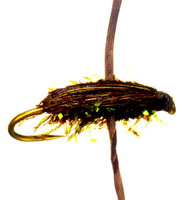
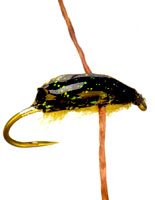
BC Outdoors fly tying columnist Ian Forbes uses a floating water boatman
pattern made of styrofoam with rubber legs and colored with felt pens.
The pattern solves many of the difficulties involved in successfully
fishing boatmen imitations. It floats very well and when fished on a
slow sinking line can be pulled under the surface in much the manner
of the naturals. After a few quick pulls, it will bob back to the surface
and thus will take fish both on the way down and while bobbing back
to the surface. Most strikes occur either dead-drift on the surface
or on the way down.
Fishing
Tip
The grayling-like rise forms of rainbow trout taking water boatmen is
unusual enough to provide a valuable clue. Watch for high-arching head
and tail rises during early spring, but especially late in September.
This activity normally occurs close to shore.
Be sure
to visit Fishbc.com for angling information!
Back to introduction