colours
run from black and brown to maroon; solid or mottled.
average
size is up to 50 mm, but some have reached up to 150 mm when fully extended.
flattened
body, segmented like an earthworm.
Life Cycle:
reproduction
is on an "individual" basis; all leeches are capable of producing egg
masses which they attach to an object under the water surface.
Food:
leeches
are scavengers who feed on decaying or dead organic matter but will
also hunt insect larvae, snails and shrimp.
Habitat:
leeches
like to live in shallow areas with a good covering of vegetation or
woody debris which provides both food and cover.
will also
be found in dark lakes with abundant cover of lilly pads.
Movement:
they have
sucking discs on each end of the body which enables them to "inch" along
an object or the lake bottom'.
they swim
with an undulating up and down motion.
Fishing Techniques:
fish seem
to find leeches more appealing in spring and again in mid to late summer.
fish close
to the bottom in shallow waters.
retrieve
with continuous hand twists or long slow strips.
can use
trolling to imitate the leeches swimming, as they cause considerable
movement with their undulating motion; boat speed and direction should
be varied.
the evening
is often a good time as it is thought that leeches do most of their
travelling and food search at night.
fish prefer
the young small leeches up to 1 1/2 inches.
in deeper
waters use a sinking line and a weighted fly; retrieving using a pull,
rest, sink movement.




 LEECH
LEECH
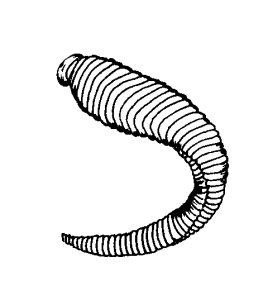 Description:
